
Manual techniques in physical therapy: restoring joint mobility in Zaporizhzhia
We work with our hands where movement is restricted: soft techniques for tight muscles and fascia, restoring joint mobility, gentle mobilisation within the physiological range. Sessions are one-on-one with a physical therapist in practice since 2012. The first consultation takes about 60 minutes and already includes an assessment, testing and the first hands-on work.
One thing up front, because it is the most common misunderstanding: in Ukraine a "manual therapist" is a medical doctor, and our specialist is not one. The hands-on techniques a physical therapist uses are a different, narrower kind of work, explained below.
The information on this page does not replace a medical consultation. A physical therapist does not diagnose and does not prescribe treatment.
In short: three things worth knowing before you book
What we do with our hands
Soft techniques for muscles and fascia, gentle mobilisation within the range the joint already has, and exercises that lock in the result. Full list.
What we do not do
No spinal manipulation, no "putting vertebrae back in place", no thrusts, no working "for the crack". Why that is.
When you need a doctor first
Pain after an injury, numbness, increasing weakness in an arm or leg, fever, night pain at rest. Full list.
A medical manual therapist and manual techniques in physical therapy are two different things
This section sits near the top of the page on purpose.
In Ukraine, manual therapy is a medical specialty. A manual therapist is a physician with a background in neurology or orthopaedics plus a separate specialization. They diagnose, refer patients for imaging and are licensed to perform spinal manipulation — short thrust movements often accompanied by the familiar popping sound. That is a medical intervention with its own contraindications, and only a doctor may perform it.
Oleksandr Kaliuzhnyi is a physical therapist, not a physician. So this office offers no spinal manipulation, no "vertebra adjustments" and no thrust techniques — they are outside a physical therapist's scope. Saying so before your visit is more honest than afterwards; if that intervention is what you want, you need a physician of the relevant specialty.
So what does a physical therapist do with their hands? They work on whatever limits your movement: tight muscles, tissue that lost its elasticity after an injury or long immobility, a joint that no longer reaches its usual range. And they select the exercises that hold on to the mobility you regain: hands open a window, exercise keeps it from closing the next day.
Who does what:
- diagnosis, X-rays and MRI, medication, injections, spinal manipulation, decisions about surgery — a physician: family doctor, neurologist, orthopaedic trauma surgeon, neurosurgeon, manual therapist;
- movement, strength, range of motion, loading technique, soft hands-on techniques and mobilisation within the physiological range — a physical therapist;
- muscle tension and preparing tissue for load — therapeutic massage;
- temporary support for an area under load — kinesio taping, an addition to exercise, never a replacement.
Not sure which you need? Call and describe the situation — if the request falls outside our scope, we will say so directly.
What we work with
- restricted mobility in the shoulder, knee, hip or ankle — after an injury, surgery or a long period without movement;
- stiffness in the morning or after long sitting, a "wooden" back and neck;
- local muscle tension and tender, dense spots in the back, neck and shoulder girdle;
- the period after a cast or brace comes off, when the joint moves less than it should;
- restrictions that keep you from exercising through the full range — then hands-on work opens the session;
- preparing muscles and joints for load within a physical therapy (exercise therapy) programme.
If your main complaint is pain in the lower back, neck or a joint that has dragged on for weeks, start with the back, neck and joint pain page: manual techniques are then one component of the programme.
The techniques we use
Soft techniques for muscles
Slow work with tight muscles: pressure at varying depth, lengthening along the fibres, work with tender dense spots. The goal is not to force the muscle open, but to let it release, so the next exercise can be performed more freely.
Fascia and tissue glide
Fascia is the sheath that wraps around muscles and lets them glide relative to one another. After an injury, surgery or long immobility that glide is reduced, and movement meets resistance before the joint reaches its limit. The work here is slow, with modest force and long holds.
Joint mobilisation within the physiological range
Mobilisation means slow, rhythmic movement of a joint through the range it already has, approaching the edge of comfort gradually. No thrusts, no going past the anatomical limit, no attempt to "add" a range the joint was never built for. It recovers range lost to pain, swelling or immobilisation.
Neuromuscular techniques
Alternating tension and relaxation: for a few seconds you gently push the muscle against the therapist's hand, then release — and the movement becomes slightly larger. You are a participant here rather than a passive object, which is why this technique transfers well into home exercises.
Passive movement after surgery
After operations and long immobilisation, part of the range is initially produced by the therapist while you only monitor your sensations, always within the limits set by your surgeon — more on this stage on the recovery after injuries and surgery page.
Why hands-on techniques do not work in isolation from exercise
Let us be honest: the effect of hands-on work on its own is temporary. Mobility usually improves after a session — but if you return to the same loads and habits, within days everything is back where it was. Hands change the tissue here and now; only what you do every day holds the result.
That is why manual techniques at Rehab Place are always part of a programme: first we remove the restriction, then you perform an exercise in the newly available range, and at home you repeat it every day. It is also why we do not sell a "course of ten sessions" up front — there is more hands-on work at the start, and the share of exercise grows from there.
How a session goes
We start with an assessment: the joint's range of motion, a comparison with the opposite side, and a check of what exactly limits the movement — pain, muscle tension, or the joint itself. We ask about your loads and previous injuries and operations.
Then comes hands-on work with the areas that need it. Intensity is guided by your feedback: it can go deep, but never "through pain". Pain during a session is a signal to reduce the force, not something to endure, so we keep asking how it feels.
Straight after the hands-on part come exercises in the range that has just become available — a mandatory stage, not a bonus. You leave with one or two simple exercises: two sessions a week at the office will not replace short daily repetitions.
When you need a doctor first, rather than a session
Hands-on work is not right for every situation. Some signs call for an examination rather than a session:
- pain that started after a fall, a blow or a road accident — especially if you are over 50 or have known osteoporosis;
- numbness, pins and needles, or weakness in an arm or leg that is getting worse;
- disturbed bladder or bowel control together with back pain — a reason to call emergency services on 103;
- fever, chills, swelling and redness around a joint;
- pain that wakes you at night, does not depend on your position and does not ease at rest;
- recent spinal or joint surgery, if your doctor has not cleared that area for hands-on work;
- known joint instability, a recent fracture, thrombosis, a history of cancer, or long-term corticosteroid use.
This list is not a diagnosis — it is a filter, so you do not spend weeks in sessions where an examination is what you need. If you have a doctor's report or imaging, bring it: we do not rewrite other prescriptions, but we work within the limits your doctor set.
Your first visit
It takes about 60 minutes: a conversation and the history of the problem, an assessment and mobility testing, a recovery plan, and the first hands-on work with exercises. Bring comfortable clothes, a change of shoes and any medical documents.
Address: 28 Pavlokichkaska St., Zavodskyi district, Zaporizhzhia — office address and how to get here.
Accessibility
The office is on the ground floor — no stairs inside. There is a ramp at the entrance to the Zavodskyi Palace of Culture building, and parking next to it. Doorways are not narrowed.
Worth knowing in advance: the restroom in the building is not adapted for visitors with reduced mobility — please take this into account when planning your visit.
Cost and booking
The first consultation costs UAH 300 for about 60 minutes of work. Service members and veterans get 30% off the consultation and sessions: UAH 210 instead of 300.
The cost and frequency of further sessions are set after the assessment — they depend on your condition, daily loads and goals. Reference figures are on the session costs page.
To book, call +380 97 824 48 01 and say which movement is restricted, how long it has been that way, and what preceded it.
Opening hours: Mon–Fri 09:00–19:00. Saturday by prior appointment. Sunday closed.
See also: physical therapy (exercise therapy), therapeutic massage, back, neck and joint pain, recovery after injuries and surgery, back pain: who to see, session costs.
Questions and answers
Are you a manual therapist?
No. Oleksandr Kaliuzhnyi is a physical therapist, and in Ukraine "manual therapist" is a medical specialty. We use hands-on techniques within a physical therapist's scope: soft work with muscles and fascia, joint mobilisation within the physiological range. See the section above.
Do you "adjust" vertebrae? Will there be a cracking sound?
No. Spinal manipulation — the short thrust movements that often produce that sound — is performed by a physician; a physical therapist does not do it. Our hands-on work is slow, without thrusts, and stays within the joint's physiological range.
How is this different from massage?
In its goal. Massage works primarily with muscle tension and circulation. Manual techniques target a specific restriction: restoring range to a joint, restoring the ability of tissue to glide. Massage at the office is given by massage therapist Alona Kaliuzhna; within a recovery programme the two approaches can complement each other, with the specialists coordinating their work. See the massage page.
Does it hurt?
Work with tense areas can be noticeable, but never painful "by force". A rule of thumb: pain should not spike sharply during the work, and afterwards it should settle back to its previous level within hours, not the next day.
How many sessions will I need?
It depends on how restricted the movement is, how long it has been that way, and what you do at home. We give an approximate plan after the first consultation and adjust it as you progress. An exact number named in advance would not be honest.
Can I come for hands-on work only, without exercises?
Start with a consultation — after the assessment we will say honestly whether that would give a lasting effect. If the restriction is held in place by weak muscles or movement habits, hands alone bring relief for a few days, and we will suggest adding exercise.
Do I need a doctor's referral or imaging?
Referrals for imaging come from a physician, so there is no need to arrange an MRI before your visit.
Do you make home visits?
The main format is sessions at the office on Pavlokichkaska Street. Home visits are considered case by case — ask when you call.
Are sessions available in English?
Yes — in Ukrainian, Russian or English. Mention English when booking so we can allow enough time for the assessment conversation.
The information on this page does not replace a medical consultation. For questions about diagnosis, imaging, medication and safe loading, please consult your treating physician.
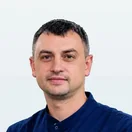
This page was prepared by Oleksandr Kaliuzhnyi — physical therapist, in practice since 2012.
Updated:
Book the way that suits you
We answer during working hours. If we miss your call, we'll call you back.
Request received
We will call you back during working hours to arrange a convenient time for your visit.
Request a call back
Leave your contact details — we'll call you back and arrange a time.