
Rehabilitation after amputation: from the residual limb to walking on a prosthesis
For Ukrainian Armed Forces service members and veterans, amputation is usually the result of a blast or gunshot injury, and the questions afterwards are the same: when does the prosthesis come, will walking be possible, why does something that is gone still hurt. Between the operation and the first steps on a prosthesis lies a long stretch of work with the body, and it decides how usable the prosthesis will be.
Below: both stages — preparing the residual limb, then learning to walk on a finished prosthesis — plus phantom pain, the overloading of the rest of the body, and the line between therapist and prosthetist. Reading from abroad? Start with the sections on who does what.
This page is informational and does not replace a medical consultation. A physical therapist does not diagnose, does not prescribe treatment, and does not decide when prosthetic fitting begins.
Two stages, with different jobs
Before the prosthesis, the job is to make the residual limb fit to bear load and the body fit to tolerate it: shape and volume, swelling, joint mobility, sensitivity, strength in the remaining limb and trunk, balance without two points of support, endurance.
With the prosthesis, the job is to teach the body to use a new kind of support. A prosthesis does not give the leg back; it offers a point of contact with different rules — different feedback, a different response to uneven ground, a different pattern of step. That is a separate skill; wearing the device does not produce it. Between the stages sits the fitting itself, not our part.
Hence the commonest mistaken expectation: most of the work that decides how usable a prosthesis will be happens before it exists.
Preparing the residual limb: before the prosthesis
Shape and volume. A socket is made to fit one specific shape, and after surgery the limb is swollen, its volume still changing for weeks or months. Compression garments and bandaging are prescribed by a doctor or prosthetist; improvised bandaging does more harm than good.
Swelling. Managed within the limits the doctor has set: positioning, movement of the adjacent joints, general activity. A sudden increase is a question for a doctor.
The wound and the scar. Wound care is the work of a nurse and a surgeon, and no instructions on it appear here. A movement specialist comes in later, once the wound has healed: then it matters whether the scar moves freely and how it sits inside a socket.
Prevention of contractures. The strongest single influence on fitting — see the next section.
Desensitisation. The limb is usually hypersensitive after surgery: ordinary touch registers as sharp, because nerve endings that once served the whole limb now end at the incision. Accustoming the tissue to contact is not about comfort: a socket presses closely for hours, and the body must accept it calmly.
Strength, balance, endurance. Without trunk and remaining-limb strength a prosthesis will not work, whatever it cost. Walking on one costs more energy than ordinary walking, so endurance is a precondition. General principles: physical therapy.
Why limb position in the first weeks decides so much
When something hurts, the body finds the position in which it hurts least: usually a bent knee after a below-knee amputation, a flexed and outward-turned hip after an above-knee one. Comfortable positions — and that is what makes them dangerous. A joint held one way for weeks gradually loses the ability to straighten fully: first a habit, then a fixed restriction — a contracture — that willpower no longer undoes.
The stakes are high: a prosthesis is designed around a joint that straightens. If it does not, the design becomes a compromise or fitting is postponed until the joint can be worked back — sometimes fully, sometimes not.
The positioning regime is set by the treating doctor; no ready-made positions appear here, deliberately. One thing can be said with confidence, and relatives are often best placed to act on it: how to lie and sit over the next few weeks without losing the joint belongs to a conversation with the doctor before discharge.
Phantom pain: what it is and what is done
Three things are routinely called by one name. Phantom sensations — the felt presence of the limb: position, itching, tingling, toes that are not there; common, not a complication. Phantom pain — pain in the part that is gone. Pain in the residual limb itself — a different matter with different causes, which more often needs examination.
Why it happens. In simplified terms: parts of the nervous system that spent years receiving signals from the limb carry on working after the source disappears, while the brain keeps building the missing part from an outdated map. Not imagination, not a psychiatric disorder — so "it's all in your head" has no place here.
What is done. The medical side belongs to a doctor: examination, ruling out other causes, medication. A movement specialist works within their own limits — graded desensitisation, work with load and limb position, approaches such as mirror therapy, agreed with the doctor.
And the honest part: there is no universal way to remove phantom pain, and no one can promise it will go. In some it fades; in others it persists and needs long-term management.
Pain that is increasing, has returned after a settled period, or comes with redness, swelling or fever is not phantom pain. It is a reason to see a doctor.
When prosthetic fitting begins, and who is involved
Readiness for a first socket is decided neither by the person nor by the physical therapist, but by the doctor and the prosthetics facility, on the state of the wound, the stability of limb volume and other injuries.
- The doctor — medical management, condition of the limb, readiness for load, timing.
- The prosthetics facility — measurement, manufacture of the socket, components, fitting, alignment, socket replacement as volume changes, repair.
- The physical therapist — prepares the body, then teaches walking on the prosthesis the prosthetists made.
We give no timelines. For readers unfamiliar with the system: prosthetic provision for service members and veterans is state-funded and runs through licensed prosthetics facilities, not rehabilitation practices. The wider recovery process: physical therapy after a combat injury.
Gait training on a prosthesis
It starts with standing, not walking. How weight is shared between the sides, whether the trunk hangs over the remaining leg. Over the months before fitting the body learned not to load the missing side; that habit goes first.
Weight transfer. Technically straightforward, psychologically the hardest step: the weight goes onto a piece of engineering, and the person must believe it will hold. Until that trust exists, no step follows.
Gait. Step length, time on each side, pelvic movement, trunk position. The typical pattern is a shorter step and a quick hop over the prosthetic side; unaddressed, it becomes fixed and brings low back pain.
Stairs, kerbs, uneven ground. Separate skills, not "the same thing more slowly": going up and going down work differently, and grass, sand, ice and a slope test the gait as a flat floor never does.
Falls. Raised reluctantly, and among the most practical parts of the work: reducing the risk, falling more safely, getting up from the floor unaided. Someone who can get up alone moves outdoors differently.
Endurance. A prosthesis is not worn all day at first; wearing time and load build up gradually, guided by the state of the limb and the prosthetist.
No exercises or dosages appear here, deliberately: what suits a below-knee amputation does not suit an above-knee one.
The other side of the body, remembered too late
While one limb is out of action, the rest of the body absorbs its workload, for years unless someone intervenes. The remaining leg works for two, taking most of the weight in standing, turning and walking with aids. The spine takes an asymmetric load, first on crutches and then on the prosthesis until the gait evens out; shoulders and wrists are overloaded by crutches and transfers. The consequences appear months later: the lower back, the knee of the remaining leg, the foot, the shoulder.
Against the scale of an amputation this looks like a detail, which is why it gets skipped — and why a person with a good prosthesis often walks less than they could.
Where the boundary runs: the prosthetist makes the device
This boundary is firm. Everything about the prosthesis as an object — measurement, socket, components, fitting, alignment, socket replacement, repairs — is done by the prosthetics facility. The physical therapist prepares the body for the device and teaches walking on what the prosthetists made: we do not select the design, assess its suitability, or decide on timing.
The consequence is simple. If a session shows the problem lies in the device — the socket presses or rubs, a persistent red mark appears, the prosthesis rotates — nothing gets adjusted by us. Load stops and the person goes back to the prosthetist. Pushing on in a socket that does not fit damages the limb and undoes the work before it.
When to see a doctor, not wait for the next session
Signs calling for examination by a doctor or prosthetist rather than a session:
- redness, swelling or local heat over the residual limb;
- discharge from the wound, wound separation, slow-healing areas;
- darkening of the skin or a change in tissue colour;
- a rise in body temperature with no other obvious cause;
- an abrupt change in limb volume, increase or shrinkage;
- new or increasing pain at rest, unlike the usual pattern;
- a rub mark, blister or open area where the socket contacts.
If we see any of these during a session, load stops: most serious residual-limb problems look minor early on.
State-funded options exist too
We will say this plainly, though this is a paid practice: if a state programme covers what you need, use it. Rehabilitation care is included in Ukraine's medical guarantees programme, hospital rehabilitation departments and veterans' hubs are running, and prosthetic provision is state-funded. Routes and paperwork: free rehabilitation for service members. Paid sessions make sense while waiting for a place.
Practical details
What to bring: the discharge summary, imaging and reports, the surgeon's recommendations, and — if a prosthesis already exists — the device itself. No referral is needed.
Accessibility of the premises, stated honestly. The room is on the ground floor, no stairs inside. The building has a ramp at the entrance, parking alongside, and doorways with no narrow points. But the toilet in the building is not adapted for visitors with reduced mobility — plan around that, particularly for a longer visit. Better to know in advance than on arrival. Home visits are not a standing service, but are considered case by case.
Terms. A first consultation costs 300 UAH; serving members of the Ukrainian Armed Forces and veterans get 30% off the consultation and sessions: UAH 210 instead of 300 — the final figure, not a starting price. Sessions are run one to one by physical therapist Oleksandr Kaliuzhnyi, in practice since 2012. More on this work: rehabilitation for service members and veterans in Zaporizhzhia. Questions about a specific case: +380 97 824 48 01. See also prices and contacts.
Funding this from abroad? The device and the rehabilitation around it are paid for separately, by different organisations — and the preparatory stage, cheap next to the device, is the part most often left out of a plan.
Questions and answers
Where does rehabilitation after amputation start?
With assessment, not exercises: the state of the residual limb and wound, mobility of the adjacent joints, strength, balance, endurance, the condition of the remaining limb and spine — checked against the surgeon's restrictions.
Do you make prostheses?
No. The device is manufactured, fitted and aligned by a prosthetics facility. We prepare the body for it and teach walking on it. Socket, components, replacement and repair: the prosthetist.
Can phantom pain be removed?
No one can promise that. The medical side is led by a doctor; ours is desensitisation, work with load and limb position, and approaches agreed with the doctor.
When will walking on a prosthesis be possible?
We give no timelines. Readiness for fitting is determined by the doctor and the prosthetics facility; the pace of gait training depends on the level of amputation, the state of the limb and other injuries.
Do you help with the psychological side?
No — that belongs to psychologists and psychotherapists. Our part is movement, strength, balance and a return to ordinary physical demands.
This page is informational and does not replace a medical consultation. Decisions on the timing of fitting, the level of load and the medical management of the residual limb are made by the treating doctor.
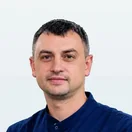
This page was prepared by Oleksandr Kaliuzhnyi — physical therapist, in practice since 2012.
Updated:
Book the way that suits you
We answer during working hours. If we miss your call, we'll call you back.
Request received
We will call you back during working hours to arrange a convenient time for your visit.
Request a call back
Leave your contact details — we'll call you back and arrange a time.